


16
Sep
A practical guide for sign shops and print operators on how eco-solvent ink works, what makes it different from solvent and UV ink, and why ink quality directly affects your printer's performance and lifespan.
QUICK ANSWER: Eco-solvent ink is a pigment-based ink suspended in a mild, low-VOC solvent carrier. When printed, the solvent softens the top layer of the substrate just enough for the pigment to bond into it, then evaporates, leaving a durable, scratch- and water-resistant print. It sits between water-based ink (safe but less durable) and strong solvent ink (very durable but high-odor/high-VOC) — offering outdoor durability of 1–3+ years with low odor, making it the standard choice for signage, vinyl, and vehicle wrap printers. Ink quality is also one of the biggest factors in printhead lifespan, so not all eco-solvent ink performs the same, even if it looks similar on paper.
If you've ever compared an eco-solvent printer spec sheet to a UV or water-based machine, "eco-solvent ink" is probably the term you've seen the most — but rarely explained in a way that helps you make a buying or maintenance decision. This guide breaks down what eco-solvent ink actually is, how it works at the substrate level, and why the ink you choose matters just as much as the printer itself.
Eco-solvent ink is made of color pigments suspended in a solvent carrier — a liquid that's mild enough to be low-odor and lower in volatile organic compounds (VOCs) than traditional "hard" solvent ink, but still active enough to interact with the substrate surface.
Here's what happens during printing:
This is why eco-solvent prints resist scratching and light rubbing far better than water-based prints: the color isn't just sitting on the surface, it's partially fused into the material itself.
| Eco-Solvent Ink | Strong Solvent Ink | UV-Curable Ink | |
|---|---|---|---|
| Odor / VOC level | Low | High | Low (no evaporation) |
| How it "sets" | Solvent evaporates, pigment bonds into substrate | Solvent evaporates, deeper bonding | UV light instantly cures ink on the surface |
| Outdoor durability | 1–3+ years, longer with laminate | 3–5+ years | 1–2 years unlaminated, varies by formulation |
| Substrate compatibility | Vinyl, PVC, banner, wallpaper, most coated media | Vinyl, PVC, banner | Rigid and flexible; wider material range including non-porous |
| Ventilation needed | Minimal | Forced ventilation recommended | Minimal |
| Typical use case | Signage, vehicle wraps, banners, wallpaper | Heavy-duty outdoor, industrial graphics | Rigid signage, packaging, textured/embossed effects |
Eco-solvent ink is generally the balance point: strong enough for most outdoor and commercial jobs, without the ventilation requirements of strong solvent or the equipment cost of a full UV setup. That's why it remains the standard ink type for sign shops running 1.6m, 1.8m, and 3.2m format printers.
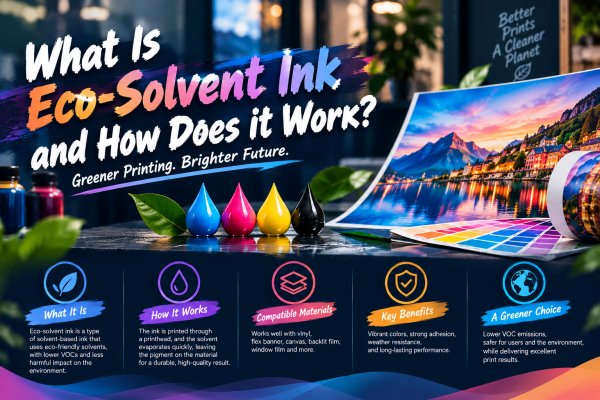
The common requirement across all of these is a coated or receptive surface — eco-solvent ink needs a surface the solvent can interact with, which is why uncoated or fully non-porous materials (like raw glass or metal) generally require UV ink instead.
Not all eco-solvent ink is formulated the same way, even when it's labeled for the same printer. Ink quality affects your printer in three practical ways:
This is also why mixing ink brands, or switching between original and compatible ink without flushing the system properly, is consistently the leading cause of permanent printhead clogs — a point covered in more depth in our guide on Eco-Solvent Printhead Clogging: Causes & Fixes. Using ink formulated specifically for your printhead system, such as Stormjet's Eco Solvent Ink, removes this variable entirely.
Is eco-solvent ink actually eco-friendly?
It's more accurate to call it "lower impact" — eco-solvent ink has significantly fewer VOCs and less odor than strong solvent ink, but it isn't a fully green or water-based formulation. The "eco" refers to reduced environmental and operator impact, not zero chemical content.
Does eco-solvent ink need a laminate for outdoor use?
It's not always required, but lamination roughly doubles outdoor lifespan and adds scratch resistance, which is recommended for vehicle wraps and high-traffic signage.
Can I mix eco-solvent ink brands in the same printer?
It's not recommended. Mixed ink is one of the leading causes of permanent printhead clogging, since different formulations can react chemically inside the ink lines and damper.
How long does eco-solvent ink last once opened?
Most eco-solvent ink has a shelf life of 6–12 months once opened, depending on storage conditions. Keep cartridges sealed, away from direct sunlight, and within the recommended temperature range.
Is eco-solvent ink better than UV ink?
Neither is universally "better" — eco-solvent is generally more cost-effective for flexible, coated media like vinyl and banners, while UV ink handles a wider range of rigid and non-porous substrates. See our comparison guide: Eco-Solvent vs UV Printer: Which Is Right for Your Business?
Not sure which ink is right for your printer model?
Stormjet's technical support team can help you match the correct ink formulation to your printhead system and recommend the right settings for your media.