

06
Aug
Eco-solvent or UV printer? Compare ink cost, media compatibility, durability and ROI to choose the right large format printer for your print shop in 2026.
If you are shopping for a new large format printer, you have almost certainly landed on the same question every sign shop owner faces sooner or later: should I buy an eco-solvent printer or a UV printer? Both machines print vivid, large-format graphics — but they use completely different ink chemistry, target different materials, and fit different business models.
This guide breaks the decision down into plain numbers: ink cost, media compatibility, durability, drying time, and total cost of ownership — so you can match the right technology to your product mix before you spend five or six figures on new equipment.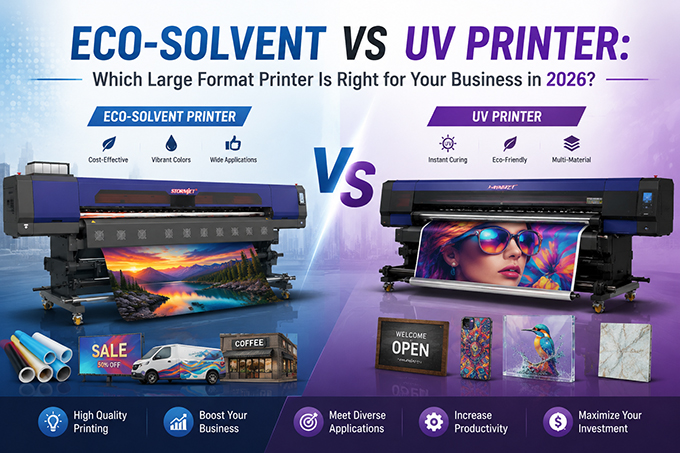
An eco-solvent printer uses solvent-based ink with a lower concentration of volatile organic compounds (VOCs) than traditional solvent ink. The ink is sprayed onto flexible roll media — vinyl, PVC, banner cloth, one-way vision film, mesh — and then dried with a built-in heater as it penetrates the surface. Because the ink actually bonds into the media rather than sitting on top of it, eco-solvent prints hold up well outdoors without needing white ink or extra coating for most jobs.
Eco-solvent printers such as the Stormjet SJ-7160S and the four-head Skycolor H1 are the workhorses of the advertising and sign industry: banners, car stickers, billboards, photographic paper, and large-format wallpaper all run through eco-solvent machines every day.
A UV printer sprays UV-curable ink that hardens instantly under an LED UV lamp instead of drying with heat. Because there is no absorption step, UV ink can be printed on almost any flat or slightly curved material — acrylic, glass, metal, wood, leather, ceramic tile, PVC board — which is why the industry sometimes calls UV printing the "universal printer." UV printers also support white ink and varnish, enabling spot-gloss, raised 3D texture, and Braille-style embossed effects that eco-solvent ink cannot reproduce.
Stormjet's UV lineup covers both formats: the SC-2513 UV flatbed printer for rigid boards and signage, and roll-fed hybrid machines like the SC-1906 UV printer for both rigid and flexible media in one machine.
| Factor | Eco-Solvent Printer | UV Printer |
|---|---|---|
| Ink type | Eco-solvent ink (CMYK + Lc/Lm), heat-dried | UV ink (CMYK + White + Varnish), light-cured |
| Media compatibility | Flexible roll media: vinyl, banner, PVC, mesh, backlit film | Almost any material: acrylic, wood, metal, glass, leather, plus flexible media |
| Drying time | Needs heat to dry; slight waiting time before finishing | Instant cure, ready to handle immediately |
| Outdoor durability | Around 1–3 years unlaminated; longer with lamination | 3–5 years, excellent UV and abrasion resistance |
| Special effects | None — flat print only | White ink, gloss varnish, raised 3D texture |
| Ink cost per sqm | Lower | Higher |
| Machine investment | Lower entry cost | Higher entry cost |
| Best for | Banners, vehicle wraps, stickers, wallpaper, backlit signage | Rigid signage, décor panels, promotional gifts, packaging samples |
Many established shops eventually add a UV printer alongside their eco-solvent machine. The eco-solvent unit keeps handling everyday roll-to-roll banner and sticker volume at a low ink cost, while the UV printer opens the door to higher-margin rigid-substrate and specialty décor orders — without turning away business either machine can't handle alone.
Yes, both the printer itself and the ink typically cost more for UV printing. However, UV printing eliminates lamination and drying labor for many jobs, which can offset part of the higher ink cost on rigid-substrate work.
Standard eco-solvent and UV printers use different ink systems and curing methods, so a single printhead setup cannot switch between them. Some manufacturers offer hybrid UV printers that accept both rigid and flexible media, but that is different from switching ink types.
UV prints generally offer stronger outdoor durability — roughly 3 to 5 years — thanks to the instantly cured, wear-resistant ink layer. Eco-solvent prints typically last around 1 to 3 years outdoors unless laminated.
An entry-level eco-solvent printer is usually the lowest-cost way to start, since both the machine and ink are more affordable, and vinyl banners and stickers remain some of the highest-demand products in the sign industry.
Stormjet manufactures both eco-solvent and UV large format printers, so you can start with the machine that matches your current order mix and expand later without switching suppliers.
Not sure which model fits your production volume and budget? Contact our team for a free recommendation.