

10
Aug
A practical, spec-based comparison for sign shops, sticker producers, and wide-format print businesses deciding between eco-solvent and UV DTF technology.
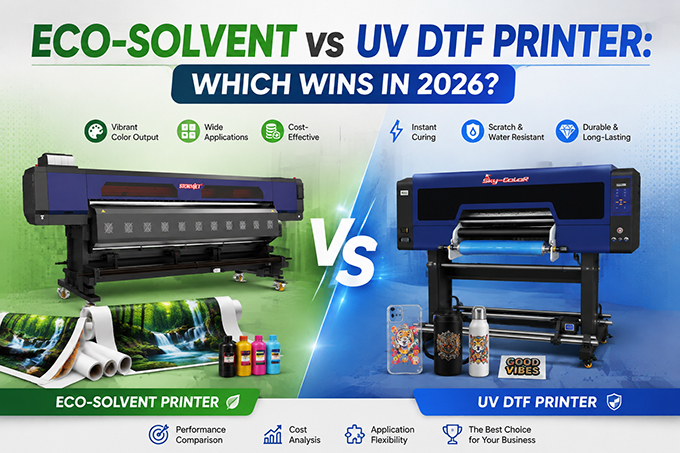
QUICK ANSWER: Choose an eco-solvent printer if you mainly produce car stickers, vinyl banners, wallpaper, or lightbox graphics on flexible roll media and want the lowest cost per square meter. Choose a UV DTF printer if you need instant-cure transfer stickers that can be applied to almost any surface — glass, metal, ceramic, plastic, wood — with a raised, glossy 3D texture and no lamination step. Many sign shops that scale past their first year end up running both, using eco-solvent for large-format vinyl work and UV DTF for small-batch, high-margin custom stickers and decals.
If you sell wide-format prints, sooner or later you'll face this question: should your next machine be an eco-solvent printer or a UV DTF printer? Both can produce stickers. Both are widely used for signage and personalization businesses. But they solve different problems, and picking the wrong one can cost you thousands in wasted ink, rework, or a machine that just doesn't fit your order mix.
This guide breaks down how each technology actually works, where each one wins, and how to decide — using real specifications from Stormjet's own eco-solvent and UV DTF printer lines as reference points.
An eco-solvent printer uses a mild, low-VOC solvent-based ink that chemically bonds with the surface of flexible media — vinyl, banner PVC, self-adhesive film, wallpaper, and photographic paper. The ink slightly etches into the coating of the material rather than sitting on top of it, which is why eco-solvent prints are known for scratch resistance and long-term outdoor durability (typically 2–3 years unlaminated, longer with lamination).
Because the ink needs to off-gas and cure, eco-solvent printing has a short drying time after printing — usually a few hours before lamination — but no special curing equipment is required.
Typical eco-solvent applications:
A UV DTF (Direct-to-Film) printer prints UV-curable ink onto a transfer film, then applies an adhesive layer so the design can be peeled and stuck onto almost any rigid or flexible surface — think crystal stickers, tumbler wraps, phone case decals, glass and metal signage, or personalized labels. The ink cures instantly under LED UV lamps as it prints, so there's no drying wait and the finished transfer is ready to laminate and apply within minutes.
The result is a slightly raised, glossy, 3D-textured sticker with strong scratch and water resistance — one reason UV DTF has become popular for the personalized gift and small-batch sticker market.
Typical UV DTF applications:
Eco-Solvent vs UV DTF: Side-by-Side Comparison
Factor: Ink curing
Eco-Solvent: Air-dries over a few hours
UV DTF: Instant LED UV cure while printing
Factor: Best substrates
Eco-Solvent: Vinyl, PVC banner, self-adhesive film, wallpaper
UV DTF: Glass, metal, ceramic, plastic, wood, AB/plasma film
Factor: Surface texture
Eco-Solvent: Flat, flush finish
UV DTF: Raised, glossy 3D texture
Factor: Typical run size
Eco-Solvent: Large-format rolls, bulk vinyl and banner jobs
UV DTF: Small-batch, one-off, and on-demand stickers
Factor: Outdoor durability
Eco-Solvent: 2–3 years unlaminated (longer laminated)
UV DTF: Strong scratch/water resistance; best for mid-term use
Factor: Odor / ventilation
Eco-Solvent: Low-VOC, mild odor, minimal ventilation needed
UV DTF: Virtually odorless; no solvent off-gassing
Factor: Cost per unit
Eco-Solvent: Lower cost per square meter on large jobs
UV DTF: Higher cost per piece, but ideal for short runs
Factor: Turnaround
Eco-Solvent: Hours (drying + lamination)
UV DTF: Minutes (ready to laminate right after printing)
Machine price is only part of the equation. Here's how the total cost of ownership tends to break down between the two technologies:
Buyer tip: If more than 60% of your monthly orders are large-format vinyl, banners, or vehicle graphics, eco-solvent will almost always give you the lower cost per job. If your business leans toward personalized, small-batch, or novelty products applied to hard surfaces, UV DTF pays for itself faster through speed and substrate flexibility.
Both technologies have converged on similar core hardware in recent years — most mid-to-high-end machines now use Epson I3200 printheads for sharp detail and consistent color. What differs is the ink set and curing system:
Yes — and many established sign shops eventually do. A common setup pairs a large-format eco-solvent printer (1.6m–3.2m) for banners, wraps, and bulk vinyl work with a compact UV DTF printer for custom stickers, personalized products, and quick-turn small orders. This lets a shop bid on both high-volume signage contracts and the growing on-demand personalization market without turning away either type of customer.
Is UV DTF printing better than eco-solvent for stickers?
It depends on the sticker type. UV DTF is better for small, decorative, or novelty stickers applied to hard surfaces like glass and metal, thanks to its raised 3D texture and instant cure. Eco-solvent remains the better choice for large adhesive vinyl stickers, vehicle graphics, and any job printed on flexible self-adhesive film.
Which is cheaper to run, eco-solvent or UV DTF?
Eco-solvent is generally cheaper per square meter for large jobs because the ink cost per unit area is lower. UV DTF can be more cost-effective for very small or one-off jobs since a single sticker uses only a small amount of ink and needs no lamination wait time.
Do eco-solvent printers need lamination?
For outdoor use exceeding a year or two, lamination is recommended to extend UV and scratch resistance. Indoor eco-solvent prints, such as wallpaper or short-term signage, often don't require it.
Can a UV DTF printer replace an eco-solvent printer?
Not entirely. UV DTF is optimized for small transfer stickers on hard or mixed surfaces, not for large-format banners, billboards, or bulk vinyl rolls, which is where eco-solvent's lower per-square-meter cost and wider roll widths still lead.
UV DTF machines like the SF60-4 can reach around 8 sqm/h in standard production mode on a 600mm-wide roll, benefiting from instant UV curing. Large-format eco-solvent printers cover far more total area per hour on wider rolls (1.6m–3.2m) but need post-print drying time before lamination.
Not sure which printer fits your production line?
Stormjet manufactures both eco-solvent and UV DTF printers, from single-head entry models to high-volume 3.2m production machines. Tell us your typical order mix and we'll recommend the right setup.
Get a Free Recommendation → https://www.stormjet.net/contact.html