


09
Sep
A practical guide for print shops and sign makers explaining why outdoor prints lose color over time, and how ink type, lamination, and vinyl grade determine how long a job actually lasts.
QUICK ANSWER: Outdoor prints fade primarily because UV radiation breaks down the chemical bonds in printed pigments — a process called photodegradation — which shows up as dulling, yellowing, or color shift over months or years. Reds and yellows fade fastest; blues and greens hold up longest. The three biggest factors you control are ink type (pigment-based, UV-resistant inks like eco-solvent last far longer than dye-based ink), lamination (a laminate layer blocks UV before it reaches the print), and vinyl grade (economy vinyl fades within a single season outdoors, while cast or premium vinyl with UV protection can hold color for 5+ years). Heat, humidity, and harsh cleaning chemicals accelerate fading further.
If a customer comes back a few months after picking up a sign or vehicle wrap complaining that the colors look "washed out," it's rarely a printer malfunction — it's a predictable chemical process, and in most cases it was preventable with the right ink, lamination, and material choice from the start. Understanding why it happens lets you set the right expectations with customers upfront and recommend the right materials for jobs that actually need to last outdoors.
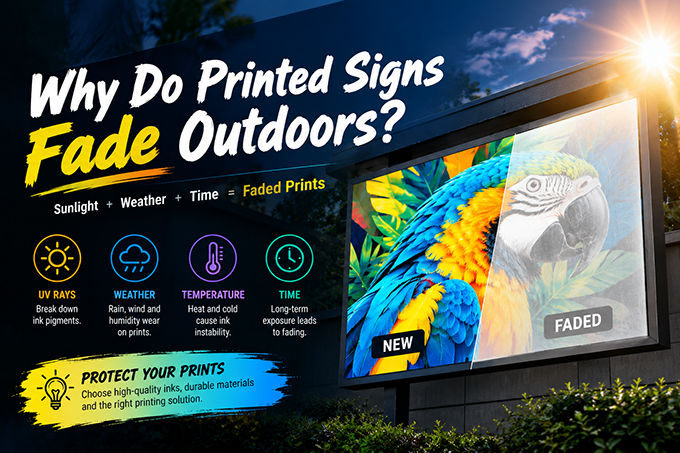
Fading isn't just "wear and tear" — it's a chemical breakdown. UV radiation from sunlight has enough energy to break apart the molecular bonds that give printed pigments their color, which is why fading shows up as dulling, yellowing, or a visible color shift rather than the ink simply "wearing off." This is why a print kept indoors or in shade can look essentially unchanged for years, while an identical print in direct sun visibly fades within months.
Heat and humidity accelerate the same process, and certain cleaning chemicals — bleach, acetone, ammonia-based cleaners — can strip away protective coatings and speed up fading further, which is why cleaning method matters as much as material choice for anything installed long-term.
| Color Family | Fade Resistance | Why |
|---|---|---|
| Red, orange, yellow | Fades fastest | Pigment molecules are more easily broken down by UV energy |
| Blue, green | Fades slowest | More UV-stable pigment structure |
| Black | Moderate | Can show fading as a shift toward gray/brown over time |
| White | Can yellow | UV exposure can cause a visible yellow tint over years |
This matters at the design stage, not just the material stage — a logo or design that leans heavily on reds and yellows for a long-term outdoor installation will show visible fading noticeably sooner than one built around blues and greens, even with identical ink and lamination.
Being upfront about expected lifespan based on the materials a customer chooses — rather than letting them assume "outdoor" automatically means "permanent" — prevents most fading-related disputes before they happen.
Can a faded sign or sticker be restored, or does it need to be replaced?
Minor fading on some rigid materials can sometimes be improved with a fresh protective coating, but for printed vinyl and stickers, once pigment breakdown has visibly occurred, replacement is almost always the more reliable and professional solution rather than attempting to "restore" the original color.
Does laminating a print really make a noticeable difference?
Yes — lamination is one of the most effective and cost-efficient ways to extend outdoor print lifespan, since it physically blocks UV before it reaches the printed pigment layer underneath.
Is eco-solvent ink UV-resistant on its own, or does it need lamination too?
Eco-solvent ink has meaningfully better UV resistance than dye-based ink on its own, but for anything expected to face years of direct outdoor sun exposure, pairing it with lamination and an appropriate vinyl grade gives significantly better long-term results than ink choice alone.
Why did my red logo fade faster than the rest of the design?
This is expected, not a defect — red and yellow pigments are consistently the most UV-sensitive color family across ink types, which is a known factor worth accounting for at the design stage for long-term outdoor graphics.
How much does cleaning method affect fading?
More than most people expect. Harsh chemical cleaners like bleach, acetone, or ammonia-based products can strip protective coatings and accelerate fading, while mild, pH-balanced cleaning products preserve both the print and any laminate significantly longer.
Want prints that actually hold their color outdoors?
Stormjet's eco-solvent printers are built around UV-resistant ink formulations designed for long-term outdoor durability — and our team can help you match the right ink, vinyl grade, and lamination combination for jobs that need to last years, not months.
Talk to Our Team → https://wa.me/8617700639356