


04
Sep
QUICK ANSWER: Vinyl stickers peel or bubble for one of four reasons: the surface wasn't properly cleaned before application, the application was rushed without a squeegee or proper technique, the vinyl or adhesive wasn't rated for the environment (outdoor UV, moisture, or cold), or the print itself wasn't fully cured or laminated before use. Bubbling is almost always trapped air from a fast or careless application; peeling usually starts at the edges and is caused by contamination, temperature, or the wrong adhesive type. Most cases are preventable with correct surface prep and material choice — and most active bubbles can be fixed without replacing the sticker.
If your shop keeps getting the same complaint — "my sticker is peeling" or "there are bubbles under it" — the cause is very rarely a defective print. It's almost always one of a handful of predictable factors: how the surface was prepared, how the sticker was applied, or whether the material was right for where it ended up. Understanding these causes lets you fix active complaints quickly and, more importantly, prevent the next one — which matters for repeat business and reviews.
| Issue | What's Happening | Most Common Cause |
|---|---|---|
| Bubbling | Air trapped between the vinyl and surface during application | Rushed application, no squeegee, wrong starting point |
| Edge peeling | Adhesive losing grip at the corners or edges first | Contaminated surface, cold application, low-quality adhesive |
| Peeling after weeks/months | Adhesive breaking down over time | UV exposure, moisture, cleaning chemicals, wrong vinyl grade |
| Returning bubbles after a fix | Bubbles reappear even after smoothing | Surface contamination (wax, silicone, oil) blocking the bond |
| Curling at the corners | Corners lift first, rest stays flat | Vinyl applied too cold, or wrong vinyl for a curved/textured surface |
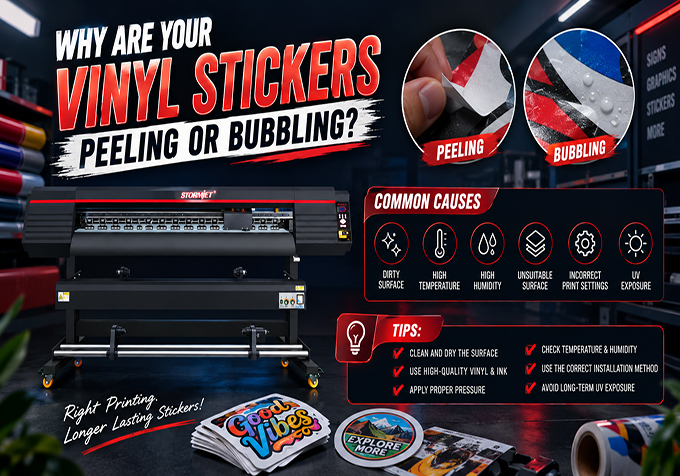
For active bubbles: Warm the bubble gently with a hairdryer on low-to-medium heat (never the highest setting, which can damage the adhesive), then smooth it toward the nearest edge with a squeegee or application card. For a persistent small bubble that won't push out, a fine pin-prick to release trapped air, followed by smoothing, usually resolves it without leaving a visible mark.
For lifting edges: Clean the lifted area with isopropyl alcohol (91%+) on a lint-free cloth and let it fully dry. Apply gentle heat for 10–15 seconds, then press firmly and hold until cooled. If the edge won't stay down after this, the adhesive underneath has likely degraded and the sticker needs to be replaced rather than re-pressed.
If bubbles keep coming back: This is a strong sign of surface contamination — wax, silicone, or residue the adhesive can't bond through. Pulling the sticker, thoroughly cleaning the surface, and reapplying is the honest fix; repeatedly smoothing over a contaminated surface will not hold long-term.
Why do my stickers bubble even when I use a squeegee?
Usually it's technique, not the tool itself — going too fast, using short choppy strokes instead of one continuous pass, or not overlapping strokes lets small air pockets get sealed in before they can escape. Slow, even, overlapping passes from one edge outward solve most of this.
How long should a properly applied vinyl sticker last outdoors?
With quality laminated vinyl, roughly 2–3 years for calendered vinyl, 3–5 years for polymeric vinyl, and 5–7+ years for cast vinyl with UV lamination. Unlaminated prints in direct sun can start showing wear within 6–12 months.
Can I reuse a sticker that's already peeled off?
Generally no — once adhesive has been exposed to air, dust, or a first application, it loses much of its bonding strength. It's more reliable to replace it than to reapply the same piece.
Is bubbling a sign of a bad print or bad application?
Almost always application, not the print itself. Bubbling is a mechanical air-trapping issue during installation, not a defect in the ink or vinyl — though using the wrong vinyl for a textured or curved surface can make it worse.
What's the biggest mistake customers make when applying stickers themselves?
Rushing the application without cleaning the surface first. If you sell direct-to-consumer stickers, including a short application tip card with the order noticeably reduces peeling complaints and repeat-replacement requests.
Want prints that hold up better from the start?
Stormjet's eco-solvent printers are built for consistent adhesion and outdoor durability across vinyl, banner, and decal media — and our team can help you match the right ink, media, and lamination combination for your customers' use case.
Talk to Our Team → https://www.stormjet.net/contact.html