

19
Aug
A practical guide for distributors, resellers, and print shop owners sourcing an eco-solvent printer manufacturer or factory — what actually matters beyond the price quote.
QUICK ANSWER: A reliable eco-solvent printer manufacturer should be evaluated on seven factors: verified certifications (ISO9001, CE), printhead options (Epson I3200 or XP600), years of manufacturing experience, after-sales support and spare parts availability, warranty terms, sample/OEM policy, and realistic lead times. Don't choose on unit price alone — after-sales support and printhead type usually matter more to your total cost of ownership than the sticker price.
Sourcing an eco-solvent printer is very different from buying one off a retail shelf. You're not just comparing specs — you're evaluating a factory's ability to support you for years after the sale, through spare parts, technical troubleshooting, and consistent build quality across every unit you order. A wrong choice here doesn't just cost you a bad machine; it costs you downtime, unhappy customers, and repeat freight costs on replacement parts.
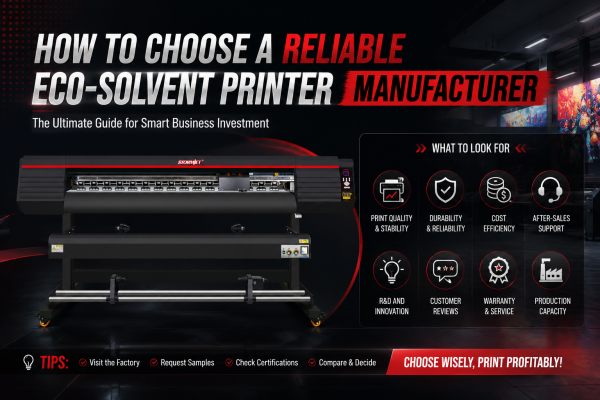
Here's what actually matters when evaluating an eco-solvent printer manufacturer, based on what experienced buyers and distributors check before placing an order.
| Factor | What to Check | Why It Matters |
|---|---|---|
| Certifications | ISO9001, CE, and RoHS compliance documents | Confirms consistent quality control and legal compliance for import/export |
| Printhead type | Epson I3200 vs XP600, and whether it's genuine | Directly affects print quality, resolution, and printhead lifespan |
| Manufacturing experience | Years in business, factory size, in-house R&D | Longer-established factories generally have more stable QC and fewer design flaws |
| After-sales support | Response time, remote troubleshooting, spare parts stock | Determines how fast you're back in production after a breakdown |
| Warranty terms | Length of coverage, what's included/excluded | Protects your investment against early hardware failure |
| Sample & OEM policy | Sample availability, private labeling, customization options | Important if you plan to resell under your own brand |
| Lead time & MOQ | Realistic production time, minimum order quantity | Affects your cash flow and how fast you can restock |
Look for ISO9001 (quality management) and CE (safety/compliance for export to Europe and beyond) certification, and ask for the actual certificate numbers so you can verify them independently rather than taking a website claim at face value. If you're importing into a region with specific electrical or environmental compliance requirements, confirm the manufacturer has documentation for that market specifically — not just a generic certificate.
Most eco-solvent printers on the market today use either Epson I3200 or Epson XP600 printheads. I3200 heads generally offer higher resolution and are built for continuous, high-volume production, while XP600 heads are more common in entry-level machines. Ask the manufacturer directly whether the printhead is genuine Epson or a compatible clone — this single detail has more impact on long-term print quality and consumable cost than almost any other spec on the sheet.
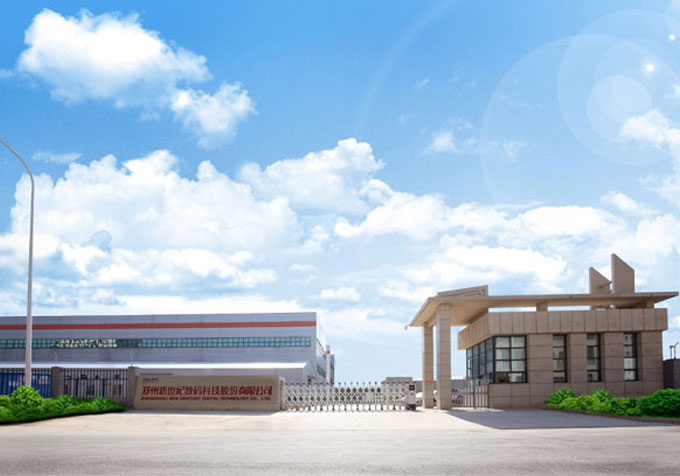
A factory that has been manufacturing eco-solvent printers for 5+ years, with its own R&D and production line (rather than reselling white-label machines from a third party), is generally a safer bet for consistent build quality. Ask directly whether the machines are manufactured in-house or assembled from third-party components — both models exist in this industry, and it changes how much control the "manufacturer" actually has over quality.
This is the factor buyers underestimate most. A printer with a slightly higher unit price but a manufacturer that offers fast remote troubleshooting, video/text technical support, and readily available spare parts will almost always cost you less over 2–3 years than a cheaper machine from a factory that goes silent after the sale. Ask specifically: What's the average response time for a support ticket? Do they stock spare printheads and boards for shipment, or do you wait weeks for a custom order?
Warranty length varies widely across manufacturers — commonly 1 year on the printer body, with printheads sometimes covered separately or excluded entirely due to their consumable nature. Get the warranty terms in writing before ordering, including what voids it (e.g., using non-recommended ink) and whether it covers parts only or parts and labor.
If you plan to resell the printer under your own brand, ask about OEM and private labeling options upfront — not every manufacturer offers this, and it's much easier to negotiate before your first order than after. If print samples matter for your evaluation, ask what the manufacturer's sample policy is and how long sample production typically takes.
Be cautious of quotes with unusually short lead times relative to competitors — it can be a sign of components already sitting in inventory (fine) or corners being cut on quality control (not fine). Ask for a production timeline in writing, and confirm the minimum order quantity matches your actual buying capacity so you're not overcommitting cash flow on your first order.
What's the difference between an eco-solvent printer manufacturer and a trading company?
A manufacturer produces the printer in its own factory and typically has more control over quality, spare parts, and technical support. A trading company resells printers made by a third-party factory, which can mean slower support and less transparency about who actually built the machine. Asking directly whether they are the factory or a reseller is a fair and common question during sourcing.
Is a lower price always a red flag?
Not necessarily, but a price significantly below the market average should prompt closer questions about printhead authenticity, certification, and after-sales support — those are the areas most commonly cut to hit an aggressive price point.
How important is the printhead brand when choosing a manufacturer?
Very important. Genuine Epson I3200 or XP600 printheads offer predictable performance and consumable costs. Compatible or clone printheads may lower the upfront machine price but often come with shorter lifespans and inconsistent print quality.
Should I ask for a factory visit or video audit?
Yes, if the order size justifies it. A manufacturer confident in its production process will typically accommodate a video call walkthrough of the factory floor, even if an in-person visit isn't practical.
What warranty length is standard for eco-solvent printers?
One year on the printer body is common industry standard, with printheads often covered under separate or shorter terms due to their consumable nature. Always get exact terms in writing before ordering.
Looking for a manufacturer you can verify, not just trust?
Stormjet has manufactured eco-solvent and UV printers in-house for years, with ISO and CE certification, genuine Epson printheads, and a dedicated technical support team for spare parts and troubleshooting. Reach out with your requirements and we'll walk you through our certifications, warranty terms, and production timeline directly.
Talk to Our Sales Team → https://www.stormjet.net/contact.html